Facebook Callosa de Ensarrià, Alicante
Dragon Reforms Dragon ReformsCosta Blanca
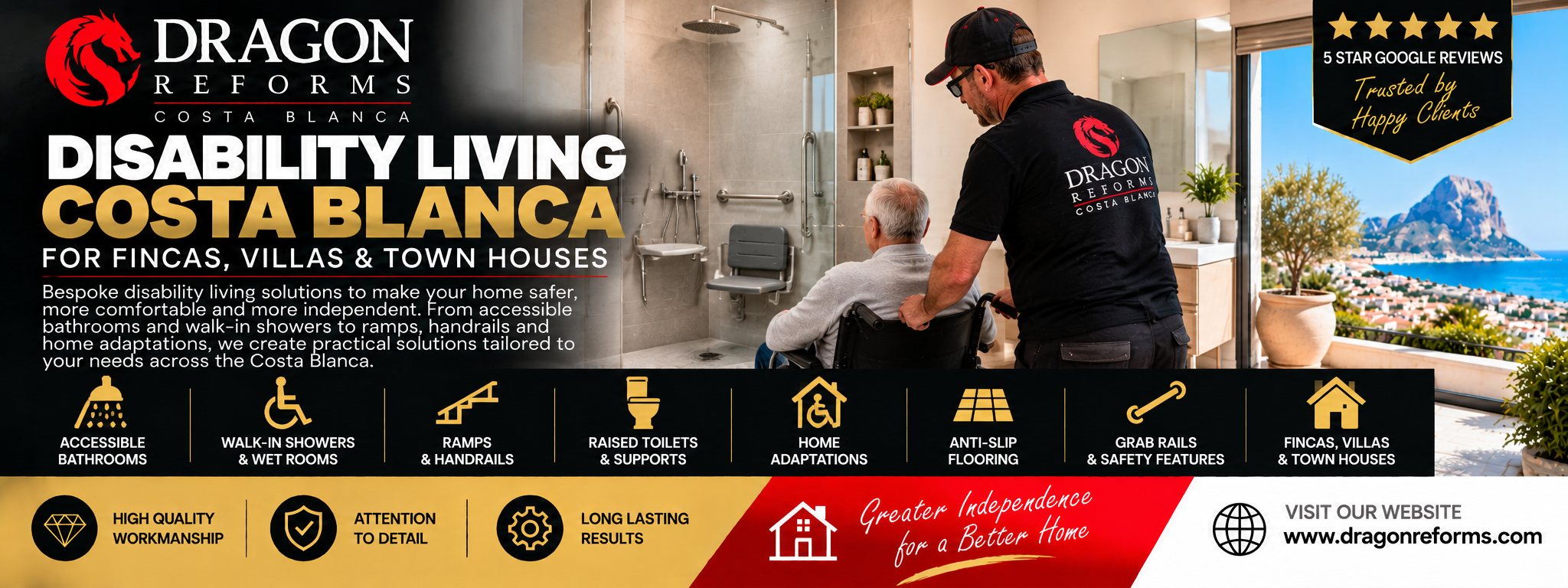
Dragon Reforms Disability Living Costa Blanca banner - a technician and a wheelchair user in an accessible bathroom, with the coast behind
Free quotations for accessible bathrooms, ramps and home adaptations across the north Costa Blanca Call 0034 639917798 WhatsApp Us Get a Free Quote Read our customer reviews

Bathrooms · Ramps · Rails · Kitchens · Pool Access

Disability Living Costa Blanca

Accessible bathrooms, walk-in showers, ramps, handrails and adapted kitchens for villas, fincas, town houses and apartments across the north Costa Blanca, planned around how you actually live in the house.

Plenty of Costa Blanca homes were built for people who could take a flight of steps, a high shower tray and a narrow hallway for granted. Then life changes. A fall, an operation, a diagnosis, or simply the years catching up, and a house that has been loved for decades becomes harder to use. Disability living work is about putting that right, so that the person who lives there, or visits, can wash, cook, get in and out and move about safely and with as much independence as possible.

We work with retirees and expats who want to stay in their own home rather than move, with families preparing a house for an older parent, with carers who need a bathroom that can be used safely by two people, and with owners of holiday homes who want relatives to be able to visit comfortably. The jobs range from a single set of grab rails to a full bathroom conversion, a ramp to the front door or a kitchen rebuilt at a lower height.

Dragon Reforms has been renovating homes across the north Costa Blanca since 1999, and our work is guaranteed, with the scope set out in the quotation. Adaptations touch plumbing, tiling, electrics, carpentry and sometimes structural work, so having one firm co-ordinate all of it means one person to talk to and one set of drawings, rather than a handful of trades who have never met.

The quotation is free. We start by looking at the house and, more importantly, by listening to how things are difficult at the moment and what you would like to be able to do again.

What is included

Disability Living Work, From First Visit to Finished Room

Adaptations only work if every detail suits the person using them. This is what we cover.

🚿Walk-in showers and wet roomsLevel-access showers with a properly formed fall to the drain, waterproofed behind the tiles, and with space for a seat or a carer to help.
🤝Grab rails and supportsRails fixed into the wall structure, not just the tile, and placed where your hands naturally reach: at the shower, the toilet, the bath and the steps.
♿Ramps and handrailsAccess ramps and continuous handrails for front doors, terraces, garden steps and sloping plots, built with a gentle gradient and a non-slip finish.
🚽Toilets and washbasinsRaised or wall-hung toilets set at the right height, with space alongside for transfer, and basins you can reach and use from a seated position.
🍳Adapted kitchensLowered worktops, open space beneath for a wheelchair, drawers in place of low cupboards, and hobs and sinks arranged so you can cook safely.
🛡️Anti-slip floors and safer layoutsSlip-resistant tiling, removed thresholds, better lighting and wider doors, so the whole home is easier and safer to move through.

Why it matters here

Adapting a Home on the Costa Blanca

The coast brings its own particular obstacles for anyone with reduced mobility.

The north Costa Blanca is a lovely place to grow older, which is why so many people retire here. But the way homes are built here does not always help. Hillside villas are reached by steps, sometimes many of them, and terraces are often on several levels. Fincas can have uneven yards, stone thresholds and doors made for a different era. Town houses in old centres tend to be tall and narrow, with steep internal stairs and small rooms.

Then there are the floors. Smooth ceramic and polished stone tiles are cool in summer and easy to clean, which is exactly why they are everywhere. They are also very slippery when wet, and a bathroom, a kitchen or a terrace after rain can be a real hazard for someone who is unsteady on their feet. Choosing the right surface, not just replacing what is there, is a large part of what we do.

Apartments have their own questions. A lift may be small, a doorway may be narrow, and a bathroom may be a tight box with a high-sided tray. In a community building there may also be shared areas to consider before any work begins. We look at all of this when we visit, and we tell you plainly what can be done in the space you have.

Many owners here are also living a long way from family, or are only in the property for part of the year. That makes it more important that a home is safe and manageable when you are on your own, and easy for visitors, whether that means grandchildren, a parent who uses a wheelchair or a friend who needs a walking frame.

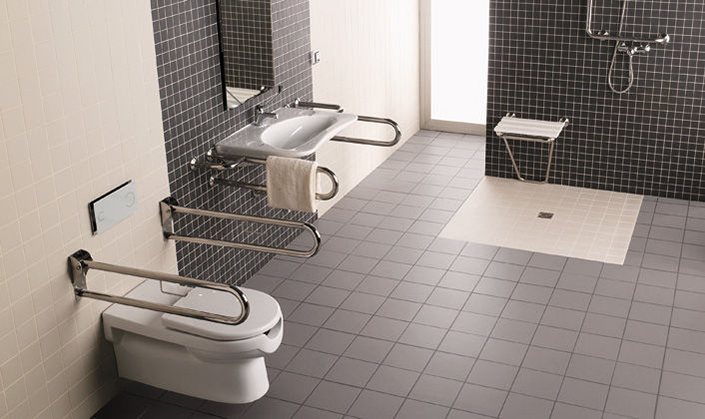
An accessible bathroom with grab rails, a wall-hung toilet, a fold-down shower seat and a level-access shower

Bathrooms

Accessible Bathrooms and Walk-In Showers

The bathroom is where most adaptation work begins, and where careful planning counts the most.

A step over the side of a bath or a high shower tray is often the first thing that becomes difficult. We replace them with walk-in showers: a level or very low entry, a floor laid to fall gently to the drain, and a waterproof build behind the tiles. Because the shower floor is built into the room rather than sitting on top of it, there is nothing to step over and nothing for a walking stick or wheel to catch on.

Inside the shower there are choices that make a real difference to comfort. A fold-down seat lets you wash sitting down and folds away when someone else uses the room. Grab rails go where you need them, at the entrance, by the seat and near the controls. The shower controls themselves can be moved to a place you can reach without twisting or stretching, and a hand shower on a slide rail suits both standing and seated use.

A wall-hung toilet is a good option in many adapted bathrooms. With no pedestal at the base, the floor is clear and easier to clean, and the height can be chosen to suit the person using it. Alongside it we fix support rails into the wall structure, with enough clear space on one side for transferring from a chair or having a carer help.

We also look at the room as a whole. The door may need widening or changing to open outward or slide. The basin may need to be moved or changed so that it can be reached from a seat. Lighting is reviewed so that the room is bright and free of glare. The aim is a bathroom that looks like a good bathroom first and works for you second.

Wet rooms

Wet Rooms and Spacious Level-Access Bathrooms

When there is room, opening the bathroom up gives the most freedom of all.

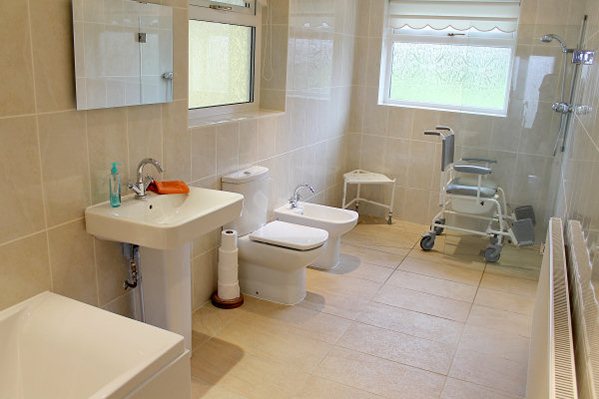
Where the space allows, a wet room or a generously sized walk-in shower area can transform how a bathroom feels to use. With no tray and no screen to negotiate, a wheelchair, a shower chair or a carer can move around freely. The whole floor slopes gently to a drain, and the walls and floor are waterproofed as one continuous system.

That waterproofing is the part that cannot be rushed. A wet room that is built carelessly will leak into the room next door or the ceiling below, which is a particular concern in apartments and in homes with a bedroom underneath. We build the waterproof layer first and test it before any tiling goes on, and we explain in the quotation what is being done and in what order.

Some people have a bathroom that is simply too small. In many houses we can gain space by combining a bathroom with a neighbouring cupboard or box room, moving a partition wall, or relocating the door. In an apartment, where walls are often shared or structural, we tell you early on what is realistic and what is not, rather than promising something the building will not allow.

A shower chair or bench is part of the plan from the start. We make sure there is room to park it, to turn it and to reach the taps, and that the floor has a finish with enough grip to be safe when wet but not so rough that it is uncomfortable underfoot or hard to clean.

A spacious bathroom with a walk-in shower and a shower chair, wash basin and toilet with room to manoeuvre

Access

Ramps, Steps and Handrails

Getting in and out of the house safely is the foundation of everything else.

On a hillside plot, the way from the road or the garage to the front door can involve a long run of steps, a steep drive, or both. Where a ramp is practical we build one with a gradient that is gentle enough to use, a surface that grips in the wet, and handrails that run the full length and continue past the top and bottom so you have something to hold at each end.

Not every plot has room for a ramp. Where there is not, the answer might be reshaping the steps themselves so that they are shallower and more even, adding a landing to rest on, putting in a handrail on each side, or improving the lighting so that steps can be seen clearly after dark. We will tell you honestly which of these suits your plot.

Inside the home, small changes make a big difference. A threshold between the living room and the terrace can be removed or replaced with a low ramp. A single step down to a kitchen or a bedroom can be levelled. Internal doors can be widened to allow a wheelchair or walker to pass, and steps on stairs can be given a non-slip edge with a rail on both sides.

Terraces, patios and garden paths deserve the same attention. Many are tiled in the same smooth ceramic that is slippery when wet, and many have drops at the edge with no barrier. We can re-surface them with a safer finish, add rails where needed and make sure that water drains away rather than pooling where you walk.

Support

Raised Toilets, Grab Rails and Safety Features

Small, well-placed supports often matter more than any large piece of work.

A great deal of independence comes from being able to stand up from a toilet, a chair or a bed unaided. A raised or correctly sized toilet reduces how far you have to lower yourself and how much effort it takes to stand again. In an adapted bathroom we set the height with the person who will use it, not by a catalogue number, and we fit rails on the wall beside it that can take real weight.

That last point is why rails are not a simple do-it-yourself job. Many walls here are hollow brick or lightweight partitions finished in tile. A rail fixed only into the tile can fail exactly when it is leaned on. We open up the wall where needed, fix a solid backing behind it, and then re-tile, so the rail holds and the wall is not damaged.

Other features are easier to overlook. A good light switch at the door, a night light to the bathroom, a seat in the shower, a non-slip mat that is actually fixed down, a hand-held shower, a tap lever you can operate with a weak grip. None of these is large. Together they take a lot of the daily risk out of a home.

We often suggest bringing in your own physiotherapist, occupational therapist or carer to the planning conversation, if you have one. They know how you move and what you find difficult, and we know how to build it. The best results come when the two are put together.

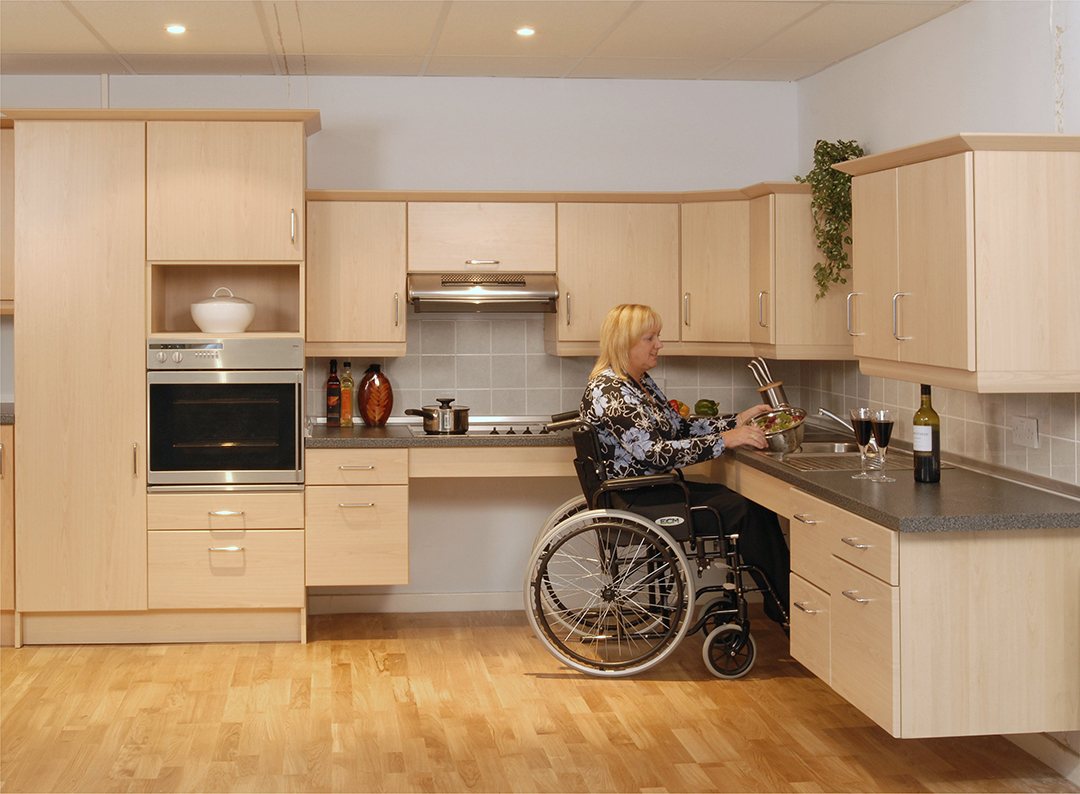
A woman in a wheelchair working at a light-wood kitchen with a lowered worktop and clear knee space beneath it

Kitchens

Adapted Kitchens

Cooking and preparing food are part of daily independence. A kitchen should let you do both.

A standard kitchen is built to a standard person: worktops at one fixed height, base cupboards that need bending to reach, wall units that need stretching for. For a wheelchair user, or for anyone with limited reach, balance or strength, that design gets in the way every day.

In an adapted kitchen the worktop is set lower, with open space underneath so a wheelchair can pull in close, and a sink and hob that you can reach and use from a seated position. Deep drawers replace low cupboards, so nothing has to be reached at the back on your knees. Wall storage is brought down to a height you can use, and the floor is a slip-resistant finish that is still easy to wipe.

Safety counts as much as access. Hobs can be placed so that you never have to reach across a flame or a hot ring, with a clear surface alongside to slide pans onto. Sockets and switches are moved to where they can be reached. Lighting is bright over the worktops and not glaring.

In some homes the best answer is to make part of the kitchen adaptable and keep the rest as a standard family kitchen, so that everyone can use it together. We design with that in mind, so the result does not feel like a clinic, and a visiting relative who stands to cook is just as comfortable as the person who sits.

Pool and garden

Pool Access and Outdoor Living

A pool is one of the great pleasures of living here, and it can be made safer for everyone.

Many Costa Blanca homes have a private pool, and for people with reduced mobility, swimming is often one of the best forms of gentle exercise. The difficulty is getting in and out. Steep pool steps and wet, smooth surrounds are a poor combination for anyone who is unsteady.

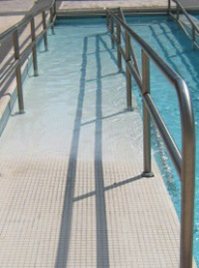
We can build a gently sloping access ramp into the pool, with handrails on both sides, so that it can be entered on foot, with a walking aid or with help from a carer. Where there is already a set of steps, handrails and a non-slip finish on the treads can make them considerably safer. Which option is right depends on the shape and depth of your pool and the space around it.

The area around the pool deserves as much thought as the pool itself. We can lay a slip-resistant surface around the edge, level out awkward changes in height and make sure there is a clear, firm route from the house to the water. If you are having a pool built or renovated at the same time, we can plan the access in from the beginning, which is far easier than adding it afterwards.

Communal pools in apartment developments are a different matter, since changes need the agreement of the community. We are happy to talk through what is possible, but we only work within what the owners of the building allow.

A handrailed access ramp running down into a swimming pool

How we work

Planning the Work and Living Through It

Adaptation work happens in a home someone is using, so the planning has to be careful.

We begin with a visit, in which we talk to you, look at the rooms and measure up. We ask how you move around the house, what causes difficulty, who else uses the space and what may change in the future. A home adapted for today only is often wrong again in a few years, so we try to allow for needs that are likely to grow.

You then receive a written quotation setting out what will be done, in what order and what is included. It is free, and the scope of the guarantee is set out in it. If a job can be done in stages, because of budget, because of time or because you cannot be without a bathroom for long, we will plan the stages so that you always have a working room.

During the work we keep the area as safe and tidy as we can. If you use a wheelchair or a walker, we think about routes through the house while the work is going on, not just once it is finished. We try to keep the bathroom out of action for as short a time as possible, and for larger jobs we explain beforehand what to expect each week.

At the end we go through everything with you, show you how each feature works and adjust anything that is not quite right. A rail that is two centimetres too high is easy to fix on the day and annoying to live with for years.

Is it time?

Signs Your Home Needs Adapting

You do not need to wait for an accident. If any of these sound familiar, it is worth talking to someone.

  • Stepping into the shower or bath feels risky
  • You avoid using the bathroom at night
  • Getting up from the toilet takes effort
  • You hold on to furniture or walls to move around
  • Steps at the front door or on the terrace worry you
  • Tiled floors feel slippery, especially when wet
  • A wheelchair or walker does not fit through a doorway
  • Kitchen worktops or cupboards are hard to reach
  • You have had a fall, or a near miss, at home
  • A carer finds it difficult to help you wash safely
  • Visiting relatives cannot manage the house
  • You can no longer get in and out of the pool safely

Making a few changes early is usually simpler and less disruptive than waiting until a crisis forces a rushed decision.

The work

Disability Living Work

A look at the kind of accessible bathrooms, kitchens and access work we carry out.

A woman in a wheelchair working at a light-wood kitchen with a lowered worktop and clear knee space beneath it
An adapted kitchen with clear space under the worktop
An accessible bathroom with grab rails, a wall-hung toilet, a fold-down shower seat and a level-access shower
Grab rails, shower seat and level-access shower
A spacious bathroom with a walk-in shower and a shower chair, wash basin and toilet with room to manoeuvre
A spacious bathroom with a walk-in shower
A handrailed access ramp running down into a swimming pool
A handrailed ramp into a pool

Images are for illustration purposes only.

Areas

Disability Living Across the North Costa Blanca

Eleven towns with their own pages, each with different housing and different challenges.

From high-rise apartments in Benidorm to hillside villas in Finestrat and fincas around Benissa, the building shapes the adaptation. Choose your town to see how we approach it locally.

Disability Living Benidorm

Walk-in showers, rails and wider doors for Benidorm apartments and old town homes.

View Benidorm →

Disability Living Altea

Ramps, handrails and accessible bathrooms for Altea's hillside old town and coastal villas.

View Altea →

Disability Living La Nucía

Wet rooms, ramps, rails and pool access for La Nucía's inland-hillside villas.

View La Nucía →

Disability Living Finestrat

Ramps, handrails and safer bathrooms for Finestrat's steep hillside villas.

View Finestrat →

Disability Living Calpe

Walk-in showers, ramps and safer kitchens for Calpe's apartments and hillside villas.

View Calpe →

Disability Living Alfaz del Pi & Albir

Accessible bathrooms, rails and ramps for Alfaz del Pi and Albir villas and apartments.

View Alfaz del Pi & Albir →

Disability Living Polop

Safer bathrooms, stairs and entrances for Polop's village houses and hillside villas.

View Polop →

Disability Living Benissa

Ramps, level showers and safer floors for Benissa's fincas, old town houses and villas.

View Benissa →

Disability Living Villajoyosa

Disability living in Villajoyosa: walk-in showers, rails, ramps and adapted kitchens for old town houses and seafront flats. Free quotation.

View Villajoyosa →

Disability Living Callosa d'en Sarrià

Disability living in Callosa d'en Sarrià: accessible bathrooms, steps, ramps and ground-floor living for village houses and fincas. Free quotation.

View Callosa d'en Sarrià →

Questions

Disability Living Costa Blanca — Frequently Asked Questions

Can you adapt an existing bathroom, or does it need to be rebuilt?

In most cases we can convert what is already there. We replace the bath or tray with a walk-in shower, change the toilet and fix supports where they are needed. If the room is too small for the equipment you need, we look at borrowing space from next door. We explain the options in the free quotation.

Are walk-in showers and wet rooms safe from leaks?

They are when they are built properly. The floor must fall to the drain and the whole area needs to be waterproofed before any tiling goes on. We do that as a standard part of the job, and our work is guaranteed, with the scope set out in the quotation.

How do you stop tiles being slippery?

We choose slip-resistant tiles or finishes for showers, bathrooms, kitchens and terraces, rather than the polished ceramic that is common in Spanish homes. We also look at drainage, so that water does not pool where you walk. We will show you samples so you can feel the difference.

Can you build a ramp for a villa on a steep plot?

Often, yes, but not every plot has the room. Where a ramp is too steep or would take too much space, we can improve the steps, add landings and fit proper handrails. We tell you honestly which approach suits your plot.

Will grab rails damage my tiles and walls?

Rails need a solid fixing, so we open up the wall where necessary, fit a backing and re-tile around it. This is the only reliable way to make sure the rail will take your weight. It means a little more work, but it is the safe way to do it.

Can I stay in the house while the work is done?

Usually yes, particularly for smaller jobs. For a bathroom conversion we plan the work so that you are without that room for as short a time as possible. For bigger projects we discuss the timing and any alternative arrangements before we begin.

Can you work with my therapist or carer?

Yes. We welcome their input, since they know how you move and what you find hard. If you would like them to come to the survey or review the plan, we are happy to arrange it. We can then build what has been recommended.

Do you work in apartments as well as houses?

Yes. Apartments have their own limits, such as shared walls, narrow doors and community rules, and we check these early on. We will tell you what is possible within your building before you commit to anything.

Which areas do you cover for disability living work?

We cover Benidorm, Altea, La Nucía, Finestrat, Calpe, Alfaz del Pi & Albir, Polop, Benissa, Villajoyosa and Callosa d'en Sarrià, and the surrounding north Costa Blanca. Each town has its own page with more detail on local property types.

Get in touch

Talk to Us About Making Your Home Easier to Live In

Tell us what is difficult at the moment and we will come and look at the house. The quotation is free, the work is guaranteed, and we are open Monday to Saturday, 9am to 8pm.

Customer reviews

What Our Customers Say

Genuine Google reviews from Dragon Reforms customers.

★★★★★

Miguel Angel Delgado

Bathroom Renovation

Original Spanish review

“Muchísimas gracias por su trabajo. Una reforma de baño espectacular y muy limpio trabajando.”

English translation

“Thank you very much for your work. A spectacular bathroom renovation, and very clean and tidy while working.”

Google Review · 5/5 · 2 years ago
★★★★★

maria teresa perez cantó

Apartment Renovation

Original Spanish review

“Hace poco reformó el apartamento. Ha quedado espectacular. Además sin imprevistos, cumpliendo los plazos y muy formal.”

English translation

“They recently renovated the apartment. It looks spectacular. What's more, there were no unexpected problems, the agreed timescales were met, and they were very professional.”

Google Review · 5/5 · 2 years ago

Read all customer reviews →

Get a quote

Get Your Free Disability Living Quotation

Tell us a little about the home and what you would like to be able to do more easily, and we will get back to you to arrange a visit.

Phone
0034 639917798
0034 669261858
WhatsApp
+34 639 91 77 98
Email
dragonreforms@gmail.com
Address
Calle San Isidre No 8, Pl 1 Dr
03510 Callosa de Ensarrià, Alicante
Hours
Monday to Saturday, 9am–8pm

Prefer to talk? Call 0034 639917798 or message on WhatsApp. We use your details only to answer this enquiry.